Archive
Race and the Health of America
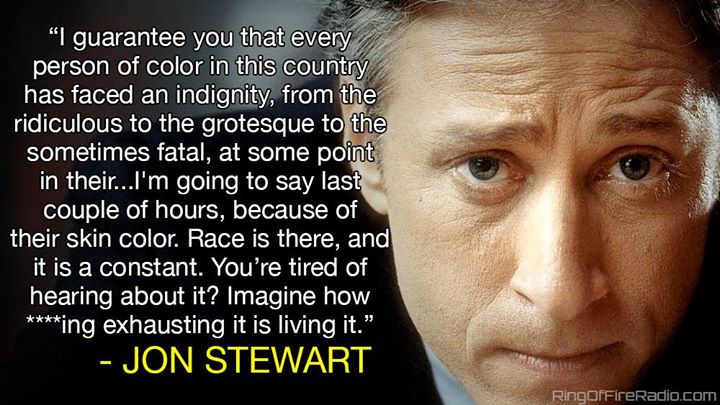
This doesn’t have much to do about health law, but it does have to do with the long-term health of America.
I like to think that I am a caring and tolerant human being. I am also a White Anglo Saxon Protestant male. I have no ethnic background worthy of opinion one way or the other. I am plain white toast with margarine. I cannot comprehend what it is to live a life filled with fear and danger when simply going about activities of normal daily living. That is inexcusable in America, and it only can change by our being constantly reminded that the problem of prejudice is real and is affecting real people.
Racism is a virus. Our health as a nation requires that virus to be obliterated. The obliteration only happens when we as a nation refuse to tolerate racism — it does not matter how the racism shows itself. Racial oriented jokes are more insidious sometimes than overt racist behavior. People of good character must be willing to say enough is enough. No more excuses and explanations about whether the person who was abused because of his race is somehow responsible the abuse.
It’s time for America to get healthy.
The Relative Contribution of Multiple Determinants to Health

The last several decades have seen a growing interest in what defines and shapes health. Despite having the highest per capita health spending, the United States lags behind many other countries in many health indicators, and glaring health disparities remain. The United States devotes a small share of its health expenditures (less than 9 percent) toward disease prevention.
…
Policy has often focused on health care rather than health, with a significant lack of emphasis on prevention, in spite of the fact, as the literature suggests, that the multilevel promotion and adoption of healthy behaviors stands to reap the most “bang” for our health care “buck.” Knowledge of the relative importance of health determinants can help design programs that prioritize interventions in areas where they are likely to have the greatest impact. However, addressing even the few determinants that are thought to be most responsible for good health requires policy makers to work across all sectors, public and private, and at the federal, state, and local level.
Go here for more on this very interesting study from Health Affairs and related research.
Charlotte’s Tangled Web — Florida’s New Law on Medical Marijuana


I invite you to register for this timely and lively program, “Charlotte’s Tangled Web – Considerations for How Doctors and Lawyers Might Avoid the Legal Entanglements of Medical Marijuana in Florida.”
It is being sponsored by Stetson University College of Law and USF Health. I will be one of the speakers.
Legal and medical continuing education credit has been applied for.
Ohio Cardiologist Indicted for Performing Unnecessay Medical Procedures
“The charges in this case are deeply troubling,” U.S. Attorney Dettelbach said. “Inflating Medicare billings alone would be bad enough. Falsifying cardiac care records, making an unnecessary referral for open heart surgery and performing needless and sometimes invasive heart tests and procedures is inconsistent with not only federal law but a doctor’s basic duty to his patients.”
“This doctor violated the sacred trust between doctor and patient by ordering unnecessary tests, procedures and surgeries to line his pockets,” Special Agent Anthony said. “He ripped off taxpayers and put patients’ lives at risk.”
Just another case where greed coupled with disregard for his patients’ welfare led a physician to commit fraud on the government and commercial insurers and to forsake his Hippocratic oath to do no harm. Here, the physician not only ordered unnecessary and more invasive procedures than the patient needed but also falsified nuclear test results to justify the unnecessary procedures.
While there is no way to prevent greed like this (other than locking the bastards up), I have predicted in other posts that the migration of medical reimbursement from procedure based to quality of care of the patient will reduce the incentive to perform unnecessary tests and hopefully reduce this kind of fraudulent activity.
AHLA Health Law Curriculum Toolkit

The American Health Lawyers Association is devoted to education on the legal issues in the healthcare field. It has over 12,000 members.
The AHLA recently published its Health Law Curriculum Toolkit to address practice readiness of law school grads wanting to practice in the area of healthcare law. The Toolkit is illuminating as to what the field of health law is and the issues and requirements that law schools and employers have in dealing with law students and law graduates interested in the field.
State Health Insurance Exchanges vs. the Immorality of Politics
So, we have two decisions from two different U.S. Circuit Courts of Appeal, Halbig v. Burwell and King v. Burwell, and coming to two different conclusions as to whether it is permissible to provide financial subsidies to residents of states which refused to establish their own health insurance exchanges.
Here is some background of the two cases (from the Daily Kos, 7/27/14, “The Halbig Case: or, the banality of conservative evil“):
[T]he Affordable Care Act expands access to health care by allowing states to create insurances exchanges on which private companies can sell insurance plans that meet federal standards. To help ensure affordability, the ACA subsidizes a certain portion of the premium on a sliding scale based on income. If a state either cannot or will not set up an exchange, there are also plans available on a federal exchange.
So far so good, right? Wrong. Because of the fervent opposition to the law, most states with Republican-controlled statehouses opted not to participate by building their own exchanges, and instead watched passively as their citizens became eligible for plans subsidized under the federal exchange. Just one problem, though: the authors of the Affordable Care Act did not seem to anticipate that states would refuse to establish exchanges out of political spite. Consequently, the provision of the Affordable Care Act authorizing the payment of subsidies refers specifically to plans under state-based exchanges, but does not explicitly authorize subsidies to help cover plans sold by the federal exchanges. The IRS issued a regulation that federal exchanges were eligible for premium subsidies. But a group of anti-Obamacare plaintiffs, headed by an attorney from the Federalist Society, argued that because Congress had not expressly mentioned subsidies to plans under the federal exchange, those subsidies were unlawful. And that argument won the first round in the DC Circuit Court, whose panel ruled that regardless of whether Congress intended the subsidies to also be available to plans under the federal exchange, a strict reading of the legislation said otherwise.
Let’s be honest. These cases are not about the stated Constitutional challenge that the President and the IRS have gone beyond the statutory authority of the Affordable Care Act. They are about politics and the continuing attacks on the President through the rant against Obamacare.
There is no concern about law or justice — and the political maneuvering is more insidious because it hides behind black robes.
If we start with the assumption that politics and politicians should have the goal of helping their constituents, under what theory does one bring these cases when the desired result will deprive millions of Americans of the health insurance that they have purchased? How have so many lost so much perspective and purpose?
The “class war” that the President is often accused of promoting is really being fueled by a conservative myopic minority. Their willingness to hurt innocent citizens of less means who are seeking health insurance and rely on the subsidies provided is just bullying aimed at achieving some political end and helping no one. Isn’t it time this immorality stopped?
Happy 68th Birthday, President Clinton! | Clinton Foundation

Happy 68th Birthday, President Clinton! | Clinton Foundation.
For fans of the former President and fans of House of Cards!
Another Hole in the Halbig Verdict | Bill of Health
Another Hole in the Halbig Verdict | Bill of Health.
Here is my view — Of the contradicting decisions, one is clearly right, and the other wrong. Getting to the right result, however, is really only politics hiding under black robes.
What Providers Need to Know Before They Balance Bill
A very important topic that can get providers into hot water if they do not take the time to understand the requirements of their managed care contracts and Florida law.


By: Karina Gonzalez
Balance billing occurs when a provider collects from a patient the difference between the amount billed for a covered service and the amount paid for that service. Balance billing does not apply when collecting deductibles, copayments or coinsurance.
Under Florida law, a provider may not balance bill a patient for any service, if an HMO is liable and responsible for payment. Contrary to what many people believe, this is true whether you are in-network or out-of-network. Even hospital based out-of-network physicians, such as anesthesiologists, pathologists, radiologists or emergency room physicians cannot balance bill HMO members where the hospital has a contract with the HMO or there was authorization given for an episode of care.
View original post 248 more words
HFMA Research Report — Value-Focused Acquisition & Affiliation Strategies
A few weeks ago, the Healthcare Financial Management Association (“HFMA”) published a report examining healthcare acquisition and affiliation activity. The report is titled “Acquisition and Affiliation Strategies” and is available as a free download.
There are no surprises in the Report’s so-called “research highlights.” In fact, the highlights are ho-hum obvious:
An emphasis on value-focused strategies. The healthcare organizations interviewed for this report understand that the best way to gain market share is by meeting care purchasers’ demand for high quality, convenient access, and competitive prices. They are seeking acquisition and affiliation partners that will help them achieve these goals.
An understanding that different needs require different approaches. Organizational needs vary greatly depending on local market conditions and the organization’s mission, existing capabilities, and future goals. Organizations are considering a range of partners and partnership opportunities to meet these needs, often pursuing several options simultaneously.
The emergence of new organizational combinations. Healthcare organizations are growing both horizontally (e.g., hospital to hospital) and vertically (e.g., healthcare system to health plan), and different types of organizations are combining forces (e.g., academic medical centers and regional health systems).
A blurring of the lines between competition and collaboration. Market conditions and organizational needs are opening up collaborative possibilities for organizations that may have viewed one another as competitors.
The need to change governance and support structures as organizations change. As organizations grow and gain new capabilities, they are reevaluating and reshaping existing board and management structures, IT systems, financial systems and fund-flow models, and physician relationships to accommodate the changes.
However, the conclusion reached by the Report is very telling:
Few doubt that the forces transforming health care today will lead to further consolidation within the industry. The difference is significant, however, between consolidation that seeks only to increase market power and an acquisition and affiliation strategy that seeks partners who can help produce the cost-efficiencies, gains in clinical quality, and access that care purchasers both need and demand. By taking the latter approach, healthcare organizations will be best-positioned to compete in their markets and win market share by offering patients, employers, and other purchasers a superior value proposition. [emphasis added]
The acquisition/affiliation focus of healthcare organizations has shifted away from market share and toward quality and cost-effective care. That is an important shift. Healthcare organizations that may have looked like good targets in the past may no longer be desirable. If an acquisition or affiliation is the goal, all parties need to make sure that their own healthcare houses are in order. Otherwise, they may be standing at the altar alone.
 Joseph Rugg's Health Law Blog