Archive
Physician EHRs: Make patient data work for you – amednews.com
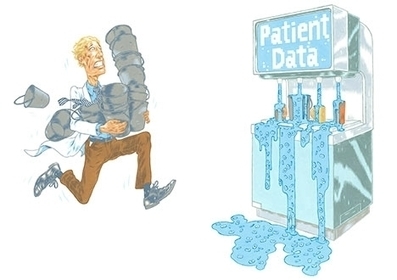
Managing the data deluge an electronic health system provides can be a seemingly onerous task, but corralling the information will improve your practice.
Thanks to electronic health records and requirements that doctors use those systems to collect and share data, physician practices have easy access to information they never had before. The data, experts say, hold a lot of power. They can transform the way physicians treat patients and run their practices.
Since the rise of EHRs, much of the talk about patient data has been geared toward so-called big data used by insurance companies, researchers and large health systems to conduct large-scale research projects, guide best practices and determine population-based health statistics. But the data that go into those repositories originate inside physician practices. Experts say that in addition to sending the data along for outside projects, the information collected within a practice’s four walls can be used for its own data projects.
Practices already are collecting and reporting certain data measurements to meet requirements of the meaningful use incentive program. But many have not used the data beyond submitting the required reports, because they probably don’t know where to start.
See on amednews.com
Independence comes at price many doctors still willing to pay – amednews.com

Physicians in private practice say they are struggling financially compared with employed peers, but that the sacrifice is worth the autonomy.
See on amednews.com
Serious Medicine Strategy: House Majority Leader Eric Cantor Shifts the Paradigm on Healthcare–From Cuts to Cures.
House Majority Leader Eric Cantor (R-VA) said on Wednesday: “If you cure disease, you no longer have to spend dollars towards treating the symptoms … of those diseases.”
Bingo. Of course, cures are cheaper than care. It’s cheaper to beat than to treat. That was the lesson of polio. A cure is cheaper than care.
If we want to “bend the curve” on healthcare costs–and we all do–this is the right way to do. Also the only humane way.
New England Leads Nation In Primary Care – Newsroom: Bernie Sanders – U.S. Senator for Vermont
With Vermont leading the way, five of New England’s six states rank in the top six for primary care doctors per capita, according to datafrom the Association of American Medical Colleges. The sixth, Connecticut, ranks 12th. As the national shortage of primary care doctors expected to increase after the federal Affordable Care Act takes full effect next year, some are looking to New England’s states with an eye to what they’ve been doing right.
Several factors contribute to New England’s relatively strong position. Among them: strong public health programs ensuring that high percentages of residents have health coverage, meaning fewer doctors deliver uncompensated care. Massachusetts, which enacted a universal health care program in 2006, has about 97 percent of its residents carrying health coverage. In Vermont it’s about 94 percent.
See on www.sanders.senate.gov
Health Affairs: For States That Opt Out Of Medicaid Expansion: 3.6 Million Fewer Insured And $8.4 Billion Less In Federal Payments
According to a study published in the June 2013 issue of Health Affairs:
[F]ourteen governors have announced that their states will not expand their Medicaid programs. We used the RAND COMPARE microsimulation to analyze how opting out of Medicaid expansion would affect coverage and spending, and whether alternative policy options—such as partial expansion of Medicaid—could cover as many people at lower costs to states. With fourteen states opting out, we estimate that 3.6 million fewer people would be insured, federal transfer payments to those states could fall by $8.4 billion, and state spending on uncompensated care could increase by $1 billion in 2016, compared to what would be expected if all states participated in the expansion. These effects were only partially mitigated by alternative options we considered. We conclude that in terms of coverage, cost, and federal payments, states would do best to expand Medicaid.
“Physician-owned hospitals seize their moment” – amednews.com
Physician owned and operated facilities are not necessarily bad places to go for healthcare.
American Medical News, amednews.com, reported in April 29, 2013:
When the federal government sorted through the first round of clinical information it was using to reward hospitals for providing higher-quality care in December 2012, the No. 1 hospital on the list was physician-owned Treasure Valley Hospital in Boise, Idaho. Nine of the top 10 performing hospitals were physician-owned, as were 48 of the top 100.
Yet, physicians can no longer own hospitals to which they refer their patients and are severely restricted from expanding those hospitals whose physician ownership was grandfathered.
The continued distrust of physicians and their vilification by Congress and most every state legislature hurts healthcare. It’s time to unburden physicians from lawyer mandated restrictions that never made any sense — repeal the Stark Law and every other restriction on physicians’ referring their patients to entities that they have an ownership in. The laws and the regulations that have been put into place are beyond comprehension and require physicians who are trying to be compliant to spend unnecessary dollars on lawyers. There are many appropriate tools for dealing with fraud and abuse by physicians who over utilize, or bill for services not performed, or who perform sub-par medicine — they can be professionally disciplined, lose their license, go to jail, fined. On the private side, they can be sued. Congress adopts these strict liability patient referral restrictions because they are easy to enforce. That should not be the basis for interfering with an entire industry.
ACOs: The Least Agreed-Upon Concept in Healthcare? | Accountable Care Organizations
Five common arguments against accountable care organizations, commentary from experts on each, and an update on Detroit Medical Center’s ACO.
1. In the grand scheme of healthcare spending, ACOs’ savings will be slight.
2. ACOs were designed on a premise that overestimated the level of integration in healthcare.
3. ACOs won’t work when healthcare still operates in a fee-for-service system.
4. ACOs will move patients out of hospitals and hurt hospitals’ revenue.
5. ACOs take healthcare back to the 1990s.
What will prove the ACO model?
The healthcare industry is still in a waiting game as far as ACOs’ results. Although a few mature ACOs like AdvocateCare (and it’s important to keep in mind that the term “mature” means that ACO is only about three years old) have reported hopeful results from its first year. Other newly launched ACOs are not yet able to disclose results. For Medicare savings, the industry has its eye on the Pioneer ACOs, and results from those 32 organizations are expected this summer.
The great EHR switch
With more electronic health record systems continuing to fall short of providers’ expectations, a recent report by Black Book Rankings suggests that 2013 may indeed be the “year of the great EHR vendor switch.”
From the 17,000 active EHR adopters polled, report officials found that as many as 23 percent of medical practices were dissatisfied enough with their EHR systems to consider trading up in the near future.
“The high performance vendors emerging as viable past 2015 are those dedicating responsive teams to address customers’ current demands,” said Black Book’s managing partner Doug Brown, in a press statement.
And in light of Stage 2, officials say provider demands are only increasing. EHR users polled cited numerous cases of software firms underperforming enough to lose crucial market share, with vendor solutions often struggling to keep pace.
Barry Blumenfeld, chief information officer at the eight-hospital MaineHealth, is among those switching EHRs. MaineHealth is in the process of transitioning from Allscripts and MEDITECH to Epic’s EHR. When describing the Allscripts Sunrise Clinical Manager system it had previously, Blumenfeld said it was a “good product,” but really lacked integration capabilities with ancillary and the departmentals. “I’ve been a fan of interoperability my whole life, but I have to say it hasn’t gone quite as fast as we would like, and the thing that’s very important about Epic,” he explained, is that it integrates all workflows for seamless movement between different products.
— This was, of course, inevitable, and it is a good thing. It takes time and practice to know what you need and how to use it when you get it. EHR is one of the most important innovations in health care, and there will be mistakes, disasters, and wasted money before we get things right.
See on www.healthcareitnews.com
Lawmaker urges extension of safe harbor for EHRs
Electronic Health Record Donation Safe Harbor
March 28, 2013
Gregory E. Demske, Esq. Chief Counsel to the Inspector General 330 Independence Avenue, S.W., Room 5527 Washington, DC 20201Dear Mr. Demske:
I write today to urge the Office of the Inspector General of the United States Department of Health and Human Services to renew its safe harbor provision that protects certain electronic health record donation arrangements under the federal Anti-Kickback Statute. As you know, this provision is set to expire on December 31, 2013. I write to respectfully ask that you consider extending this safe harbor provision. As you know, Congress is particularly interested in developing and continuing initiatives that are designed to reduce health care costs. As Ranking Member of the Ways and Means Health Subcommittee, eliminating wasteful spending in health care is an issue that is very important to me. Care coordination certainly represents good medical practice and can decrease health care costs by: (a) eliminating the need for duplicative and unnecessary testing, and (b) reducing the potential for medical errors that can occur when clinicians simply do not have all of the medical record history needed to appropriately care for a patient. The safe harbor that your agency has established, which protects the donation of electronic health records under certain limited circumstances, is a common-sense policy. It encourages collaboration among providers, yet also contains rigorous requirements that providers must meet in order to protect the Medicare and Medicaid programs from the few unscrupulous providers who would donate electronic health record software in exchange for referrals. Should you decide to extend this safe harbor provision, we are certain that you will make any necessary adjustments to protect taxpayers from fraud, waste, and abuse based upon your experience with the safe harbor thus far. Furthermore, I recommend that any extension that you publish should continue to have a corresponding sunset date so that you can address newly emerging fraud schemes that might negatively impact the federally-funded programs. I respectfully ask that you extend this important safe harbor provision as soon as is practicable so that providers have the certainty that they need to continue engaging in efforts designed to promote care coordination. I appreciate your dedication to this important issue and look forward to continuing to work with you in the future. Thank you in advance for your attention to this important matter.
Regards,
Hon. Jim McDermott, Member of Congress
See on www.modernhealthcare.com
Physicians Who e-prescribe Choose Cheaper Drugs, Report Says
Surveyed U.S. endocrinologists and primary care physicians (PCPs) said they use e-prescribing for 76 percent of their Medicare patients and 79 percent of their non-Medicare patients, figures that are expected to grow in the next year, according to a report from research and advisory firm Decision Resources. The report, which surveyed 70 endocrinologists and 70 PCPs as well as 25 managed-care organization (MCO) pharmacy directors also found that approximately 80 percent of PCPs and endocrinologists say they would prescribe a less expensive DPP-IV inhibitor to their patients with Type 2 diabetes or hypertension, reflecting high cost-sensitivity.
 Joseph Rugg's Health Law Blog